


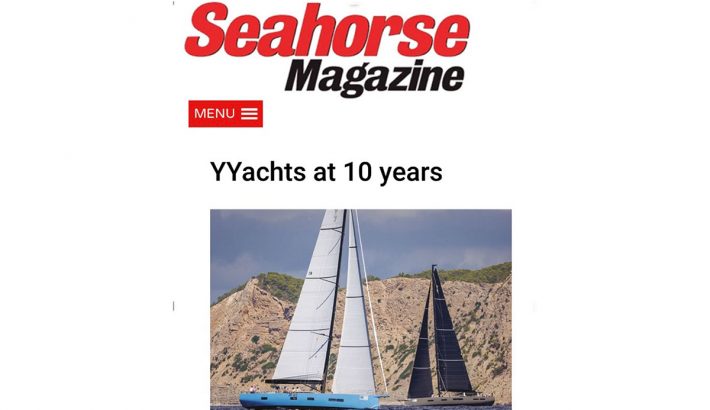
This north German boatbuilder has carved a remarkably successful niche by sticking resolutely to its founding principle of keeping things simple
When Michael Schmidt completed Cool Breeze in Greifswald in 2015, he was not, he insists, trying to start a company. He was trying to build a yacht he actually wanted to sail. This is a familiar origin story at the specialist end of the yacht business and it is worth treating with a degree of scepticism. In Schmidt’s case, however, the biography makes it rather more plausible than most.
Schmidt has more than five decades in the trade. He was a leading offshore racer during the first Admiral’s Cup era, building carbon race boats at Yachtwerft Wedel before the material became fashionable. He then founded Hanse Yachts and grew it to be the world’s thirdlargest production boatbuilder. After all that, he arrived at a clear, unfashionable conclusion: most large sailing yachts were too heavy, too complicated and also not sufficiently fun or engaging to sail.
Cool Breeze was the prototype for what would become YYachts. The company was formally established the following year. Ten years later, more than 55 carbon fibre hulls have left the shipyard. ‘Fifty years of building fast boats distilled into 10 years of YYachts,’ is how Schmidt explains it. ‘That is what you are sailing.’
Experience applied
YYachts is not a young company in the usual sense. It is the concentrated product of accumulated experience applied without particular deference to convention. Schmidt’s carbon fibre work in the 1970s and 1980s includes notable offshore racers such as Blaupunkt and Gaviosa. This pre-dates the material’s adoption in mainstream yacht construction by at least a good decade. His time at Hanse offered a rather different kind of education: what happens when the pressure to grow a business consistently outpaces the discipline to resist unnecessary complexity. Weight creeps in. Systems multiply. The pleasure of sailing quietly diminishes.
The technical team assembled at YYachts reflects the same accumulated depth. Several members bring 30 years or more of practical construction experience, across yachts from 45ft to well over 100ft. The yard remains deliberately compact, an explicit choice, not a constraint.
This density of experience matters more than it might appear. Yards that produce thoughtful, well-built yachts consistently over time tend not to be staffed by enthusiasts learning as they go. They tend to be staffed by people who have already made the expensive mistakes somewhere else.
Carbon construction, weight matters
A full carbon fibre-epoxy composite structure delivers a significantly higher stiffness-to-weight ratio than conventional GRP construction. Lower structural weight reduces displacement and allows a greater proportion of the yacht’s mass to be concentrated in ballast rather than spread across the fabric of the hull.
The benefits of carbon construction extend beyond performance figures. The weight saving of carbon compared with a conventional glassfibre yacht of similar size is substantial. The effect on a yacht’s light-air sailing ability is immediately apparent and for a typical yacht owner, this is the most obvious advantage because they tend to spend the majority of their sailing time in relatively light wind conditions. When heavier cruising yachts reach for the starter button, a boat with a properly light carbon hull continues to sail.
The art of simplification
YYachts’ guiding principle, keep it simple, functions as engineering logic before it becomes marketing language. Reduce displacement and you reduce rig loads, then you can specify smaller engines. Smaller engines mean simpler systems and lower fuel consumption over the yacht’s working life.
This argument is straightforward and it is one that many yacht building yards acknowledge in principle, while quietly ignoring it in practice. YYachts has been more consistent than most. ‘Every system you remove is a failure that will never happen,’ Schmidt explains. ‘Keep it simple and the sailing gets better.’
The deck layout of a YYacht is stripped back to the essentials of sailing. Halyards, sheets and control lines are led aft to twin helm stations, placing full management within reach of a single helmsman or a couple sailing without professional crew.
The same logic governs the interior. Rather than defaulting to the usual yacht interior designers, YYachts has quite often worked with eminent designers from outside the marine sector, pairing their instinct for proportion and restraint with the shipyard’s own technical knowledge.
These collaborations have included world-renowned architects such as Sir David Chipperfield, Norm Architects and David Thulstrup as well as yacht design specialists like Winch Design and Mark Tucker (Design Unlimited). The results feel less like conventional yacht cabins and more like considered, compact living spaces that happen to float. The interior and exterior share one design language rather than speaking of separate origins. This coherence is rarer in production sailing yachts than it ought to be.
Collaboration, not repetition
One aspect of the YYachts programme that receives rather less attention than it merits is the deliberate use of different design partners across the fleet.
Many yards, once they are commercially established, settle into a working relationship with a single naval architect and iterate cautiously around a proven platform. YYachts has not done that.
The fleet
The original Y8 and her two sister ships were built to a design by Lorenzo Argento at Brenta, whose proportions set the visual character of the first generation. Bill Tripp’s offshore experience brought considerable rigour to the Y7 and Y9.
The second-generation Y8, widely regarded as the defining yacht of the range, was developed with Javier Jaudenes at Surge Projects, whose racing background produced a particularly effective combination of generous beam and modest displacement.
The new Y7 has been comprehensively reworked by judel/vrolijk & co. Meanwhile, Tripp has returned to design the new Y6.
Whether this approach produces a coherent fleet identity is a reasonable question. The answer appears to be yes, but only because the philosophy imposes more consistency than the choice of naval architect. Each collaboration requires the yard to rebuild a working relationship from scratch, which is not the most efficient way to run a design programme. It is, however, likely to keep producing results that are at least interesting, and at best rather better than that.
The YYachts shipyard in Greifswald builds full carbon composite sailing yachts from 20m to 35m in length
A decade in brief 2015-2026
| 55+ Hulls delivered |
10 Years in production |
20+ Y7s delivered |
5+ Awards |
| Milestones | Awards | Programme for 2026 |
| 2015 First yacht Cool Breeze: Lorenzo Argento (Brenta Design) & Sir David Chipperfield 2016 Foundation of YYachts GmbH 2018 Y7 launched, Bill Tripp design 2018 Custom research vessel Eugen Seibold for Max Planck Institute 2021 Prevail (Tripp 90) launched. Palma design office expands 2022 New Y8 launched, design by Javier Jaudenes (Surge Projects) 2025 Y6 unveiled. 65ft Bill Tripp design for owner-operators 2025 New Y7 with judel/vrolijk & co 2026 55+ hulls delivered, further builds in production |
2016 Vela & Motore: Barca dell’anno – Y8 Cool Breeze 2020 Wallpaper Award: Best cabin – Y7 Bella 2022 Design Innovation Award, Genoa Boat Show – Y7 interior design 2023 Nautical Tourism Awards (LUX life) – Best luxury sailing yacht builder 2023 Best new sailboat, Newport International Boat Show – Y7 Miss Shell 2023 BOAT Design & Innovation Award: Outstanding exterior design – Y9 Bella 2024 Design Innovation Award, Genoa Boat Show – Y8 Calabash |
Apr 2026 New Y7 premiere at Palma International Boat Show Jun 2026 Inaugural YYachts Cup, 30th anniversary Palma Superyacht Cup Sep 2026 New Y6, first deliveries begin |
Y8, the keystone model
The second-generation 24m (80ft) Y8 is the fullest single expression of what YYachts is attempting. Developed with Javier Jaudenes, the hull combines generous beam with a displacement considerably below that of a comparable glassfibre yacht of similar length. Blue water capability without the weight penalty is the proposition. The evidence, after many ocean miles accumulated across the fleet, suggests that it largely delivers.
Available in standard, pilot house and custom interior configurations, the Y8 attracts owners who want serious passage-making performance without the overhead of a permanent professional crew. In that specific market, it does not have many rivals.
Y7, the bestseller, now redesigned
The original Bill Tripp-designed Y7 was the commercial engine of the YYachts yard: 20+ deliveries worldwide, a boat show award that opened the American market, and a decade of owner feedback that confirmed the design’s strengths while making clear where it could go further. The new Y7, developed with judel/vrolijk & co, addresses exactly that feedback. Among its key features are a redesigned asymmetric cockpit, a starboard U-sofa in the saloon, a dedicated aft engine room in place of the earlier under-saloon installation, and a crew companionway integrated discreetly without disturbing the deck architecture.
The yacht made its debut at Palma Boat Show in April. Twenty deliveries in eight years is a solid result for a full carbon composite yacht in this price bracket. Whether a comprehensively redesigned model can sustain that momentum is the more interesting question. The early market response suggests optimism is not unreasonable.
Y6, the latest model
The newest model in the range brings the YYachts philosophy to just under 20m (65ft). Designed by Bill Tripp specifically for owner-operators, the Y6 leads all sailhandling systems aft to the helm stations, allowing complete control from the cockpit. Carbon construction keeps displacement low while maintaining genuine offshore capability. An integrated bow thruster simplifies harbour manoeuvres. First deliveries are scheduled for autumn 2026.
YCustom division, to 35m Beyond the series fleet, the YCustom division has delivered Prevail, a 27m (90ft) Bill Tripp-designed carbon sloop with Winch Design interiors, launched in 2021 and combining regatta capability with long-range cruising comfort. Another full custom build project is Eugen Seibold, a research vessel built for the Werner Siemens Foundation and the Max Planck Institute. Launched in 2018, the centenary of her namesake’s birth, she pursues active scientific research. Together they suggest a technical range that the YYachts standard series models, impressive as they are, do not fully convey.
Looking ahead
Ten years on and 55+ hulls later, YYachts occupies an unusual position in the carbon sailing yacht market: coherent, respected and still small enough that quality control remains a matter of direct attention rather than delegated procedure. The yard has resisted the temptation – a real temptation, once the orderbook fills – to pursue volume at the expense of the founding brief.
Whether that discipline survives sustained commercial success is the more searching question. Yards that begin with a strong founding philosophy have a mixed record of preserving it through growth. Schmidt has navigated that passage once before, at Hanse, with instructive results. At YYachts, his answer appears to be to keep the yard deliberately compact: fewer yachts, built properly, by people who actually know what they are doing.
In a market where the prevailing pressure runs towards larger interiors, marina-optimised aesthetics and systems of impressive complexity, there is something useful about a yard that continues to argue the opposite case. Not because simplicity is fashionable, but because the yachts it produces genuinely sail well. That, in the end, is the point.
This is the link for the full Seahorse article: https://www.seahorsemagazine.com/article/june-2026/yyachts-at-10-years
Leave a Comment